Dementia Researcher Blogs
The Dementia Researcher Blogs Podcasts - through this show, you can hear our bloggers read their blogs. So if you prefer to read, you can head or our website or you can listen on the move. These shows are about academic / research careers, research, science and life as an early career dementia researchers. Brought to you by https://www.dementiaresearcher.nihr.ac.uk - everything you need, all in one place. Remember to subscribe to our main ‘Dementia Researcher‘ Podcast, here and where ever you get your podcasts.
Listen on:






Episodes

Wednesday Mar 13, 2024
Wednesday Mar 13, 2024
Emily Spencer, narrating her blog written for the Dementia Researcher website.
If you're playing catch-up, let us recap... Emily is a PhD student at UCL and a new mother. In this blog Emily addresses the rarely discussed intersection of academia, parenthood, and finances. Sharing her personal struggle with the exorbitant costs of childcare in London, which exceed her PhD stipend.
Emily reveals the harsh realities of managing on a limited budget when extra expenses arise with a child. As she navigates the complexities of maternity entitlements and the lack of support for student parents, particularly PhD candidates who are not considered working parents for childcare subsidies.
Emily's narrative sheds light on the need for institutions to reassess how they can better support the unique challenges faced by early career researchers with caring responsibilities. Her candid account underscores the broader issue of equity in academia, especially for women, and the urgent call for change.
Find the original text, and narration here on our website.
https://www.dementiaresearcher.nihr.ac.uk/blog-phd-finances-maternity-a-reality/
#DementiaResearch #AcademicMother #Academia #MaternityLeave #Research
--
Emily Spencer is a PhD Student at University College London looking at improving how GPs communicate with people with dementia and their family carers about their future care. Emily previous had a 5 year career break to pursue a career as a musician, and has previously undertaken research on improving the care people with dementia receive from their GP practice, as well as end-of-life and palliative care provision in the community. Emily is also a new mum and will be writing about her experiences navigating motherhood and a research career.
--
Enjoy listening? We're always looking for new bloggers, drop us a line. http://www.dementiaresearcher.nihr.ac.uk
This podcast is brought to you in association with Alzheimer's Association, Alzheimer's Research UK, Alzheimer's Society and Race Against Dementia, who we thank for their ongoing support.
--
Follow us on Social Media:
https://www.instagram.com/dementia_researcher/
https://www.facebook.com/Dementia.Researcher/
https://twitter.com/demrescommunity
https://bsky.app/profile/dementiaresearcher.bsky.social
https://www.linkedin.com/company/dementia-researcher
Monday Mar 11, 2024
Monday Mar 11, 2024
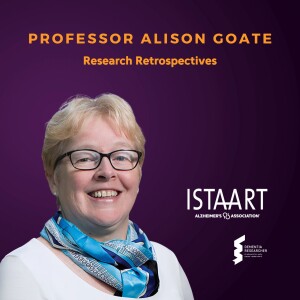
In a conversation with Dr. Claire Sexton, Professor Alison Goate discusses her career in dementia research, focusing on two of her landmark papers. The first, published in 1991, identified a missense mutation in the amyloid precursor protein gene associated with familial Alzheimer's disease. The second, published in 2021, integrated Alzheimer's disease genetics and myeloid genomics to identify disease risk regulatory elements and genes. Goate reflects on the evolution of genetic research methods, the shift in focus from amyloid and tau to the immune system, and the importance of global collaboration in Alzheimer's research. She also discusses her personal journey, including her move from the UK to the US, and the impact it had on her research and family life.
Professor Goate will be attending the the Alzheimer's Association Tau 2024 Conference - find more information at https://www.alz.org/tau
Find a transcript for this podcast, links to bios and the papers discussed in this podcast on our website:
https://www.dementiaresearcher.nihr.ac.uk/istaart-research-retrospectives-professor-alison-goate/
--
Like what you hear? Please review, like, and share our podcast - and don't forget to subscribe to ensure you never miss an episode.
If you would like to share your own experiences or discuss your research in a blog or on a podcast, drop us a line to dementiaresearcher@ucl.ac.uk

Monday Mar 11, 2024
Monday Mar 11, 2024
Dr Sam Moxon, narrates his blog written for Dementia Researcher.
Sam discusses the dilemma faced by academics between publishing research quickly and protecting their work through patents. He suggests that the "publish or perish" mentality can discourage the commercialisation of research, as it pressures researchers to publish instead of securing patents that are attractive to investors. This rush to publish can undermine the development of practical applications and commercial potential of research, potentially hindering the translation of academic work into societal and economic benefits. He advocates for a balanced approach, allowing for both academic contributions and the protection of ideas, to ensure research can truly benefit those in need.
Find the original text, and narration here on our website.
https://www.dementiaresearcher.nihr.ac.uk/blog-how-publish-or-perish-harms-research-commercialisation/
--
Dr Sam Moxon is a biomaterials Research Fellow at University of Birmingham. His expertise falls on the interface between biology and engineering. His PhD focussed on regenerative medicine and he now works on trying to develop 3D bioprinting techniques with human stem cells, so that we better understand and treat degenerative diseases. Outside of the lab he hikes through the Lake District and is an expert on all things Disney.
--
Enjoy listening and reading our blogs? We're always on the look out for new contributors, drop us a line and share your own research and careers advice dementiaresearcher@ucl.ac.uk
This podcast is brought to you in association with the NIHR, Alzheimer's Association, Alzheimer's Research UK, Alzheimer's Society and Race Against Dementia, who we thank for their ongoing support.
Friday Mar 08, 2024
Friday Mar 08, 2024
Dr Jodi Watt, narrating a new blog they wrote for the Dementia Researcher website.
In this blog Jodi's focus is on making scientific presentations more accessible. They highlight common pitfalls, such as using small font sizes or poor colour contrasts, that can make presentations exclusionary. The blog provides practical tips for improvement, such as using clear, sans-serif fonts, defining jargon, ensuring high-contrast colours, and being consistent in design. Captioning, signposting, and avoiding distracting animations are advised to make presentations more inclusive. Jodi encourages using accessibility checkers and being flexible to cater to diverse audience needs, aiming for science communication that is as inclusive as possible (and don't forget Alt Descriptions for non-decorative images).
Find the original text, and narration here on our website.
https://www.dementiaresearcher.nihr.ac.uk/blog-making-your-presentations-more-accessible/
#PresentationSkills #MakingSlides #Presenting #AcademicPresentations #AcademicTalks #PowerPointSlides #Accessibility #EDI
--
Dr Jodi Watt is a Postdoctoral Researcher at University of Glasgow. Jodi's academic interests are in both healthy ageing and neurodegenerative diseases of older age, and they are currently working on drug repurposing for dementia. Previously they worked on understanding structural, metabolic and physiological brain changes with age, as measured using magnetic resonance imaging. As a queer and neurodiverse person, Jodi is also incredibly interested in improving diversity and inclusion practices both within and outside of the academic context.
--
Enjoy listening? We're always looking for new bloggers, drop us a line. http://www.dementiaresearcher.nihr.ac.uk
This podcast is brought to you in association with Alzheimer's Association, Alzheimer's Research UK, Alzheimer's Society and Race Against Dementia, who we thank for their ongoing support.
--
Follow us on Social Media:
https://www.instagram.com/dementia_researcher/
https://www.facebook.com/Dementia.Researcher/
https://twitter.com/demrescommunity
https://bsky.app/profile/dementiaresearcher.bsky.social
https://www.linkedin.com/company/dementia-researcher
Thursday Mar 07, 2024
Thursday Mar 07, 2024
Rebecca Williams, narrates her blog written for the Dementia Researcher website.
Rebecca contemplates the journey of her work from its conception to its final goal of tangible real-world impact. She shares a personal anecdote about her first publication, reflecting on the sense of anticlimax when the anticipated change failed to materialise instantly. This experience serves as a springboard for a broader discussion on how researchers can create a more direct path to impact.
Rebecca provides practical suggestions on how to align research with NICE recommendations to ensure relevance and application in health services. She urges researchers to engage with policy-making, even in the early stages of their careers, to understand the kind of evidence that can influence decisions and replicate success. Furthermore, she emphasizes the importance of public engagement, advising researchers to consult with patients and carers to ensure their work addresses real needs and achieves its intended effect.
The blog underscores the idea that research impact should not be an afterthought but a guiding principle from the beginning of the research process. By integrating these approaches, she advocates for a more intentional and effective pathway to ensure that research does not "enter the void" but instead contributes to meaningful progress.
Find the original text, and narration here on our website.
https://www.dementiaresearcher.nihr.ac.uk/blog-research-impact-beginning-at-the-end/
--
Rebecca Williams is PhD student at the University of Cambridge. Though originally from ‘up North’ in a small town called Leigh, she did her undergraduate and masters at the University of Oxford before defecting to Cambridge for her doctorate researching Frontotemporal dementia and Apathy. She now spends her days collecting data from wonderful volunteers, and coding. Outside work, she plays board games, and is very crafty. @beccasue99
--
Enjoy listening? We're always looking for new bloggers, drop us a line. http://www.dementiaresearcher.nihr.ac.uk
This podcast is brought to you in association with Alzheimer's Association, Alzheimer's Research UK, Alzheimer's Society and Race Against Dementia, who we thank for their ongoing support.
--
Follow us on Social Media:
https://www.instagram.com/dementia_researcher/
https://www.facebook.com/Dementia.Researcher/
https://twitter.com/demrescommunity
https://bsky.app/profile/dementiaresearcher.bsky.social
https://www.linkedin.com/company/dementia-researcher
Monday Mar 04, 2024
Monday Mar 04, 2024
Dr Anna Volkmer, narrates her blog written for Dementia Researcher.
Anna reflects on her previous year's challenges and outlines her goals for 2024. She discusses the importance of annual appraisals in academia, detailing both the process and its focus on achievements and development plans, including publications, funding, and professional growth. Anna shares her ambition to publish significant research, mentioning her recent work and future aspirations. She also highlights her commitment to enhancing her skills through advanced courses, mentorship, and international collaboration, and plans to deepen her knowledge in health economics and implementation science.
Find the original text, and narration here on our website.
https://www.dementiaresearcher.nihr.ac.uk/blog-appraising-and-planning-for-the-next-year/
#DementiaResearch #Appraisal #Academia #AcademicLife #Planning
--
Dr Anna Volkmer is a Speech and Language Therapist and researcher in Language and Cognition, Department of Psychology and Language Sciences, University College London. Anna is researching Speech and language therapy interventions in language led dementia and was once voted scariest speech and language therapist (even her children agree).
--
If you would like to write your own blog drop us a line, we're always on the look out for new contributors to write about their research, careers + more dementiaresearcher@ucl.ac.uk
--
This podcast is brought to you in association with Alzheimer's Association, Alzheimer's Research UK, Alzheimer's Society and Race Against Dementia, who we thank for their ongoing support.
--
Follow us on Social Media:
https://www.instagram.com/dementia_researcher/
https://www.facebook.com/Dementia.Researcher/
https://twitter.com/demrescommunity
https://bsky.app/profile/dementiaresearcher.bsky.social
https://www.linkedin.com/company/dementia-researcher

Friday Mar 01, 2024
Friday Mar 01, 2024
Dr Yvonne Couch, narrates her blog written for the Dementia Researcher website.
The basics of gender differences in health risks include that women generally live longer than men, and age is a significant risk factor for dementia, making women more susceptible to developing it. Specifically, the Alzheimer’s Association notes that there are twice as many women with Alzheimer’s as men. With stroke risk, it varies by age; women are at higher risk before the age of 30, after which the risk is higher in men until menopause, when the risk becomes more even - find out more and get the full details in this blog, listen now, or click below to read on our website.
Find the original text, and narration here on our website.
https://www.dementiaresearcher.nihr.ac.uk/blog-lets-talk-about-sex/
--
Dr Yvonne Couch is an Alzheimer's Research UK Fellow and Associate Professor at the University of Oxford. Yvonne studies the role of extracellular vesicles and their role in changing the function of the vasculature after stroke, aiming to discover why the prevalence of dementia after stroke is three times higher than the average. It is her passion for problem solving and love of science that drives her, in advancing our knowledge of disease. Yvonne writes about her work, academic life, and careers as she takes a new road into independent research @dr_yvonne_couch
--
Enjoy listening? We're always looking for new bloggers, drop us a line. http://www.dementiaresearcher.nihr.ac.uk
This podcast is brought to you in association with Alzheimer's Association, Alzheimer's Research UK, Alzheimer's Society and Race Against Dementia, who we thank for their ongoing support.
--
Follow us on Social Media:
https://www.instagram.com/dementia_researcher/
https://www.facebook.com/Dementia.Researcher/
https://twitter.com/demrescommunity
https://bsky.app/profile/dementiaresearcher.bsky.social
https://www.linkedin.com/company/dementia-researcher
Thursday Feb 29, 2024
Thursday Feb 29, 2024
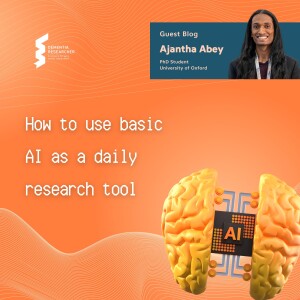
Ajantha Abey narrates his blog written for Dementia Researcher.
In this blog, Ajantha outlines the benefits and pitfalls of using AI chatbots in research. He emphasises their proficiency in language tasks and idea generation, but also warns against overreliance on AI for tasks requiring factual accuracy, as AI can fabricate data. He suggests a balanced approach to using AI as a tool to augment, but not replace, the researcher's own critical thinking and creativity - listen to his full advise in the audio version of this blog.
Find the original text, and narration here on our website.
https://www.dementiaresearcher.nihr.ac.uk/blog-how-to-use-basic-ai-as-a-daily-research-tool/
--
Ajantha Abey is a PhD student in the Kavli Institute at University of Oxford. He is interested in the cellular mechanisms of Alzheimer's, Parkinson's, and other diseases of the ageing brain. Previously, having previoulsy explored neuropathology in dogs with dementia and potential stem cell replacement therapies. He now uses induced pluripotent stem cell derived neurons to try and model selective neuronal vulnerability: the phenomenon where some cells die but others remain resilient to neurodegenerative diseases.
--
Enjoy listening and reading our blogs? We're always on the look out for new contributors, drop us a line and share your own research and careers advice dementiaresearcher@ucl.ac.uk
This podcast is brought to you in association with Alzheimer's Association, Alzheimer's Research UK, Alzheimer's Society and Race Against Dementia, who we thank for their ongoing support.
--
Follow us on Social Media:
https://www.instagram.com/dementia_researcher/
https://www.facebook.com/Dementia.Researcher/
https://twitter.com/demrescommunity
https://bsky.app/profile/dementiaresearcher.bsky.social
https://www.linkedin.com/company/dementia-researcher
Sunday Feb 25, 2024
Sunday Feb 25, 2024
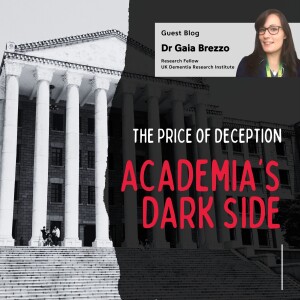
Dr Gaia Brezzo narrates her blog written for Dementia Researcher.
Gaia examines the (arguably) widespread issue of academic fraud, from the shock of discovering misconduct in familiar research to the systemic pressures that contribute to such deceit. She addresses the severe implications for public health and scientific integrity, while also discussing the need for better quality control and accountability within the scientific community. The blog advocates for a change in academic incentives and proposes utilising AI as a tool for detecting fraud, urging for a culture that protects rather than penalises whistleblowers.
Find the original text, and narration here on our website.
https://www.dementiaresearcher.nihr.ac.uk/blog-the-price-of-deception-academias-dark-side/
#DementiaResearch #AcademicMisconduct #Academia
--
Dr Gaia Brezzo is a Research Fellow based within the UK Dementia Research Institute at The University of Edinburgh. Gaia's research focuses on understanding how immune alterations triggered by stroke shape chronic maladaptive neuroimmune responses that lead to post-stroke cognitive decline and vascular dementia. Raised in Italy, Gaia came to the UK to complete her undergraduate degree, and thankfully, stuck around. Gaia writes about her work and career challenges, when not biking her way up and down hills in Edinburgh. Follow Gaia on Twitter: @Gaia_Brezzo
--
Enjoy listening? We're always looking for new bloggers, drop us a line. http://www.dementiaresearcher.nihr.ac.uk
This podcast is brought to you in association with Alzheimer's Association, Alzheimer's Research UK, Alzheimer's Society and Race Against Dementia, who we thank for their ongoing support.
--
Follow us on Social Media:
https://www.instagram.com/dementia_researcher/
https://www.facebook.com/Dementia.Researcher/
https://twitter.com/demrescommunity
https://www.linkedin.com/company/dementia-researcher