Dementia Researcher Blogs
The Dementia Researcher Blogs Podcasts - through this show, you can hear our bloggers read their blogs. So if you prefer to read, you can head or our website or you can listen on the move. These shows are about academic / research careers, research, science and life as an early career dementia researchers. Brought to you by https://www.dementiaresearcher.nihr.ac.uk - everything you need, all in one place. Remember to subscribe to our main ‘Dementia Researcher‘ Podcast, here and where ever you get your podcasts.
Listen on:






Episodes

Friday Jan 20, 2023
Friday Jan 20, 2023
Dr Yvonne Couch, narrates her blog written for the Dementia Researcher website.
Yvonne has recently been doing a lot of procrastinating, and not a lot of grant writing. In fact as she writes this, she should be either in the lab or writing a grant and yet she is not! Instead she is writing and narrating this blog. When talking to a friend about the challenge, they replied that they thought procrastination was often a response to trauma. Not big car crash, death of a loved one trauma. But trauma, nevertheless. And it got Yvonne to thinking about why we procrastinate, more importantly why she procrastinates, and whether there’s anything we can do about it.
Find the original text, and narration here on our website.
https://www.dementiaresearcher.nihr.ac.uk/guest-blog-procrastination-the-thief-of-time/
--
Dr Yvonne Couch is an Alzheimer's Research UK Fellow at the University of Oxford. Yvonne studies the role of extracellular vesicles and their role in changing the function of the vasculature after stroke, aiming to discover why the prevalence of dementia after stroke is three times higher than the average. It is her passion for problem solving and love of science that drives her, in advancing our knowledge of disease. Yvonne writes about her work, academic life, and careers as she takes a new road into independent research.
_____________________________________________________
Enjoy listening? We're always looking for new bloggers, drop us a line. http://www.dementiaresearcher.nihr.ac.uk
This podcast is brought to you in association with Alzheimer's Association, Alzheimer's Research UK, Alzheimer's Society and Race Against Dementia, who we thank for their ongoing support.

Tuesday Jan 17, 2023
Tuesday Jan 17, 2023
Dr Clarissa Giebel narrates her blog written for Dementia Researcher.
It’s only taken 2.5 years for Clarissa to finally go out to Australia as part of her Wellcome Trust funding. There was a time when she thought it would never happen, but it finally became possible to connect in real life with some researchers she has worked with remotely on routine data in dementia care, and to meet a great number of brilliant minds over there. In this blog Clarissa talks about the trip and reflects on the benefits of networking and overseas collaborations.
Find the original text, and narration here on our website.
https://www.dementiaresearcher.nihr.ac.uk/guest-blog-the-value-of-academic-travel-and-face-to-face-networking/
--
Dr Clarissa Giebel is a Senior Research Fellow at the University of Liverpool and NIHR ARC North West Coast. Clarissa has been working in dementia care research for over 10 years focusing her research on helping people with dementia to live at home independently and well for longer, addressing inequalities that people with dementia and carers can face. Outside of her day work, Clarissa has also organised a local dementia network - the Liverpool Dementia & Ageing Research Forum, and has recently started her own podcast called the Ageing Scientist.
--
If you would like to write your own blog drop us a line, we're always on the look out for new contributors to write about their research, careers + more dementiaresearcher@nihr.ac.uk
--
This podcast is brought to you in association with Alzheimer's Association, Alzheimer's Research UK, Alzheimer's Society and Race Against Dementia, who we thank for their ongoing support.
--
Note - Dementia Researcher understands the benefits of international travel to support conference attendance and collaborations. However, we want to make you aware that a return flight from London to Singapore creates 3 tonnes of CO2 per passenger. That’s the equivalent of heating a family home for a year. Please consider offsetting your flights when international travel is essential, and take the train when you can. Find more information at https://www.which.co.uk/reviews/airlines/article/carbon-offsetting-how-to-reduce-the-impact-of-flying-abuH44x4FeWn
Monday Jan 16, 2023
Monday Jan 16, 2023
Dr Kamar Ameen-Ali narrates her blog written for Dementia Researcher.
Recent years have seen various mentoring schemes pop up in academia both within Higher Education Institutions (HEIs), and through organisations and charities. This has, in part, been in response to a changing landscape over the last decade or so, which has seen an increase in precarious contract-based employment for early career researchers (ECRs), resulting in many talented scientists leaving academia for better-paid secure employment where they feel valued. In this blog Kam shares her experience of being part of two different mentoring schemes and discusses why ECRs need good mentors.
Find the original text, and narration here on our website.
https://www.dementiaresearcher.nihr.ac.uk/guest-blog-why-ecrs-need-good-mentors/
--
Dr Kamar Ameen-Ali is a Lecturer in Biomedical Science at Teesside University & Affiliate Researcher at Glasgow University. In addition to teaching, Kamar is exploring how neuroinflammation following traumatic brain injury contributes to the progression of neurodegenerative diseases that lead to dementia. Having first pursued a career as an NHS Psychologist, Kamar went back to University in Durham to look at rodent behavioural tasks to completed her PhD, and then worked as a regional Programme Manager for NC3Rs.
--
Enjoy listening? We're always looking for new bloggers, drop us a line. http://www.dementiaresearcher.nihr.ac.uk
This podcast is brought to you in association with Alzheimer's Association, Alzheimer's Research UK, Alzheimer's Society and Race Against Dementia, who we thank for their ongoing support.

Thursday Jan 12, 2023
Thursday Jan 12, 2023
Dr Diana Karamacoska narrates her blog written for the ISTAART Partnering with Research Participants PIA, shared by Dementia Researcher (this blog has also been published in Spanish).
People from culturally diverse backgrounds, particularly those that do not speak English, tend to be excluded from dementia research. This is a pressing issue considering the disparities associated with these populations accessing information about dementia, diagnostic support, interventions, and care services in highly multicultural places like Australia, UK, and USA. Seeing the impacts of these gaps in our own communities inspired Diana and the ISTAART Partnering with Participants PIA to make dementia research accessible, inclusive, and equitable. They are now sharing the lessons they've learnt so that other teams can intentionally embrace diversity (and avoid the hiccups they encountered).
Find the original text, and narration here on our website.
https://www.dementiaresearcher.nihr.ac.uk/istaart-blog-fostering-inclusivity-in-dementia-research-and-teams/
--
Dr Diana Karamacoska is a Postdoctoral Research Fellow at Western Sydney University with a background in cognitive neuroscientist. Diana is moving in to the the public health field after seeing the stigma, health disparities, and lack of appropriate education about dementia in multicultural communities. Diana is also Vice Chair of the ISTAART Partnering with Research Participants PIA.
Research for dementia therapeutics and care occurs in a world that is constantly changing. We can improve accessibility and meaningfulness of research by integrating perspectives of participants in the design and conduct of research, as well as in the way results are disseminated. A global forum is needed for researchers to share best practices on how to partner with participants, as well as opportunities to learn directly from the lived experiences of a diverse group of research participants. The ISTAART Partnering with Research Participants PIA, works with existing PIAs and leverage existing groups to ensure broad access and applicability.
--
Enjoy listening? We're always looking for new bloggers, drop us a line. http://www.dementiaresearcher.nihr.ac.uk
This podcast is brought to you in association with Alzheimer's Association, Alzheimer's Research UK, Alzheimer's Society and Race Against Dementia, who we thank for their ongoing support.
Enjoy listening? We're always looking for new bloggers, drop us a line dementiaresearcher@ucl.ac.uk

Thursday Jan 12, 2023
Thursday Jan 12, 2023
Gabriela Caballero narra un blog escrito por la Dra. Diana Karamacoska publicado en Dementia Researcher en nombre de ISTAART Partnering with Research Participants PIA (This blog has also been published in English).
Las personas de orígenes culturalmente diversos, particularmente aquellas que no hablan inglés, tienden a ser excluidas de las investigaciones sobre la demencia. Este es un tema urgente considerando las disparidades asociadas con el acceso de estas poblaciones a información sobre la demencia, apoyo diagnóstico, intervención, y servicios de atención en lugares altamente multiculturales como Australia, el Reino Unido y los Estados Unidos. Al ver estas diferencias de equidad en nuestras comunidades, inspiró a nuestro equipo a hacer la investigación en demencia accesible, inclusiva y equitativa. Ahora estamos compartiendo las lecciones que hemos aprendido para que otros equipos puedan adoptar la diversidad y evitar los problemas con los que nosotros nos enfrentamos.
Encuentre el texto original y la narración aquí en nuestro sitio web..
https://www.dementiaresearcher.nihr.ac.uk/istaart-blog-fostering-inclusivity-in-dementia-research-and-teams/
--
Dr Diana Karamacoska is a Postdoctoral Research Fellow at Western Sydney University with a background in cognitive neuroscientist. Diana is moving in to the the public health field after seeing the stigma, health disparities, and lack of appropriate education about dementia in multicultural communities. Diana is also Vice Chair of the ISTAART Partnering with Research Participants PIA.
Gabriela Caballero (who provided the Spanish translation and narration for this blog) is a Researcher and PhD candidate in the NICM Health Research Institute, Western Sydney University. She recently completed a Bachelor of Psychology, during this time she worked as a crisis supporter and as a research assistant on multiple dementia-related projects. Gabriela's PhD focuses on improving the quality of life for multicultural communities impacted by dementia.
Research for dementia therapeutics and care occurs in a world that is constantly changing. We can improve accessibility and meaningfulness of research by integrating perspectives of participants in the design and conduct of research, as well as in the way results are disseminated. A global forum is needed for researchers to share best practices on how to partner with participants, as well as opportunities to learn directly from the lived experiences of a diverse group of research participants. The ISTAART Partnering with Research Participants PIA, works with existing PIAs and leverage existing groups to ensure broad access and applicability.
--
Enjoy listening? We're always looking for new bloggers, drop us a line. http://www.dementiaresearcher.nihr.ac.uk
This podcast is brought to you in association with Alzheimer's Association, Alzheimer's Research UK, Alzheimer's Society and Race Against Dementia, who we thank for their ongoing support.
Enjoy listening? We're always looking for new bloggers, drop us a line dementiaresearcher@ucl.ac.uk
Thursday Jan 12, 2023
Thursday Jan 12, 2023
Hannah Hussain narrates her blog written for Dementia Researcher.
In this blog Hannah discusses Health Outcomes. It is well known that some groups in the population have significantly poorer health outcomes and worse experiences of using health and care services than others. Overall, experts agree that the best health outcome following interaction with healthcare services or delivery of an intervention (or research intervention) should be one that the person recieving feels is the best - but how is that measures? (because we do like our checks and balances) In this blog Hannah explains all things outcomes related, hopefully this will be a helpful blog to those that may be finding this topic a little intimidating.
Find the original text, and narration here on our website.
https://www.dementiaresearcher.nihr.ac.uk/guest-blog-outcomes-matter/
--
Hannah Hussain is a PhD Student in Health Economics at The University of Sheffield. As a proud third generation migrant and British-Asian, her career path has been linear and ever evolving, originally qualifying as a Pharmacist in Nottingham, then Health Economics in Birmingham. Her studies have opened a world into Psychology, Mental Health and other areas of health, and with that and personal influences she found her passion for dementia.
--
Enjoy listening? We're always looking for new bloggers, drop us a line. http://www.dementiaresearcher.nihr.ac.uk
This podcast is brought to you in association with Alzheimer's Association, Alzheimer's Research UK, Alzheimer's Society and Race Against Dementia, who we thank for their ongoing support.
Enjoy listening? We're always looking for new bloggers, drop us a line dementiaresearcher@ucl.ac.uk

Wednesday Jan 11, 2023
Wednesday Jan 11, 2023
Dr Megan Polden narrates her blog written for Dementia Researcher.
In her first blog for Dementia Researcher, Megan writes about her passion for older peoples research and improving the lives of people living with dementia. We hear about the amazing work on her PhD, which explored the use of eyetracking technology as a biomarker, and now about the plans for her first postdoc position, evaluating and exploring the benefits of singing and dancing as a support for both careers and people living with dementia in the community.
Find the original text, and narration here on our website.
https://www.dementiaresearcher.nihr.ac.uk/guest-blog-evaluation-of-singing-dancing-interventions-for-dementia/
--
Dr Megan Polden is a Postdoctoral Research Associate at University of Liverpool, currently researching the effectiveness and accessibility of singing and dancing intervention services for people living with dementia. Megan completed her undergraduate degree, masters and PhD at Lancaster University. Her PhD examined memory and inhibitory control processes in Alzheimer's Disease and mild cognitive impairment and examining whether eye tracking could be an effective method to measure these processes. Follow Megan on Twitter: @MeganPolden
--
Enjoy listening? We're always looking for new bloggers, drop us a line. http://www.dementiaresearcher.nihr.ac.uk
This podcast is brought to you in association with Alzheimer's Association, Alzheimer's Research UK, Alzheimer's Society and Race Against Dementia, who we thank for their ongoing support.
Tuesday Jan 10, 2023
Tuesday Jan 10, 2023
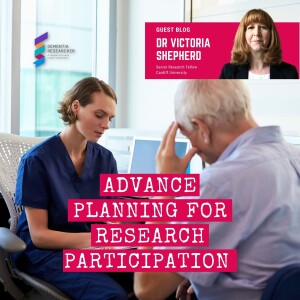
Dr Victoria Shepherd narrates her blog written for Dementia Researcher.
Do you have experience of struggling to recruit people to your research study? Both Alzheimer’s Research UK and Alzheimers’ Society have highlighted the shockingly low participation in dementia research compared to other major health conditions. Recent announcements of a ‘national mission’ to tackle dementia and funding to strengthen capacity and capability in dementia research are, of course, very welcome. However, the barriers to recruiting sufficient numbers of people living with dementia will also need to be addressed. Could there be other ways to look at this challenge? Vicky discusses in this blog.
Find the original text, and narration here on our website.
https://www.dementiaresearcher.nihr.ac.uk/guest-blog-advance-planning-for-research-participation/
--
Dr Victoria Shepherd is a Senior Research Fellow at Cardiff University where she leads a programme of research to improve inclusivity of under-served groups in trials, with a particular focus on the ethical and methodological challenges around involving adults who lack capacity to consent. She leads a number of trials methodology research projects, including the development of the NIHR INCLUDE Impaired Capacity to Consent Framework which helps researchers to design more inclusive trials. Victoria is a registered nurse and is also involved in the design and conduct of a range of clinical trials and national and international studies in care homes. Follow Vicky on Twitter: @VickyLShepherd
--
Enjoy listening? We're always looking for new bloggers, drop us a line. http://www.dementiaresearcher.nihr.ac.uk
This podcast is brought to you in association with Alzheimer's Association, Alzheimer's Research UK, Alzheimer's Society and Race Against Dementia, who we thank for their ongoing support.

Wednesday Jan 04, 2023
Wednesday Jan 04, 2023
Dr Sam Moxon, narrates his blog written for Dementia Researcher.
If you follow Sam's work with Dementia Researcher you may have stumbled upon his podcast series “Food for Thought”. It’s a show Sam sits down with medical doctors who specialise in treating their patients by complementing modern medicine with well-evidenced, beneficial diet and lifestyle choices. They talk about the best foods you can eat in order to keep your brain in the best possible shape and reduce your risk of developing dementia.
If you have listened to any of those podcast episodes you will have learned that there is a wealth of evidence out there that, in many cases, genes merely load the gun for developing dementia. Diet and lifestyle pulls the trigger. So much so that diet and lifestyle choices are the biggest controllable risk factors for developing dementia. More specifically, eating healthy and exercising is one of the best things to do for your brain and there is a recurring theme from every podcast guest: avoid processed foods and bad fats. There are various ways of doing this but the easiest way to do it is to get more plants on your plate. Fruits, vegetables, grains, legumes etc. and this brings us to the topic for this podcast - January is a month of change and it may be the 5th January, but you're not too late to try Veganuary, in this blog Sam talks you through how to get through it.
Find the original text, and narration here on our website.
https://www.dementiaresearcher.nihr.ac.uk/guest-blog-top-tips-for-veganuary/
--
Dr Sam Moxon is a biomaterials scientist at the University of Manchester. His expertise falls on the interface between biology and engineering. His PhD focussed on regenerative medicine and he now works on trying to develop 3D bioprinting techniques with human stem cells, so that we better understand and treat degenerative diseases. Outside of the lab he hikes through the Lake District and is an expert on all things Disney.
Enjoy listening and reading our blogs? We're always on the look out for new contributors, drop us a line and share your own research and careers advice dementiaresearcher@nihr.ac.uk
This podcast is brought to you in association with Alzheimer's Association, Alzheimer's Research UK, Alzheimer's Society and Race Against Dementia, who we thank for their ongoing support.