Dementia Researcher Blogs
The Dementia Researcher Blogs Podcasts - through this show, you can hear our bloggers read their blogs. So if you prefer to read, you can head or our website or you can listen on the move. These shows are about academic / research careers, research, science and life as an early career dementia researchers. Brought to you by https://www.dementiaresearcher.nihr.ac.uk - everything you need, all in one place. Remember to subscribe to our main ‘Dementia Researcher‘ Podcast, here and where ever you get your podcasts.
Listen on:






Episodes
Thursday Nov 10, 2022
Thursday Nov 10, 2022
Dr Kamar Ameen-Ali narrates her blog written for Dementia Researcher.
Historically, cognitive assessments for dementia diagnosis have relied on pencil and paper measures administered by a clinician. These tests are designed to evaluate various cognitive domains, such as memory, visuospatial abilities, and language, and should indicate whether there are potential signs of dementia. However, performance on these tests can be strongly influenced by other factors, such as cultural background or educational level. There are questions relating to whether such tests have the sensitivity to detect early stages of diseases, like Alzheimer’s, which is crucial if this is when treatments are most effective. In this blog Kam discusses how technology is being used to advance cognitive assessments used in dementia diagnosis.
Find the original text, and narration here on our website.
https://www.dementiaresearcher.nihr.ac.uk/guest-blog-advances-in-digital-cognitive-assessments-for-dementia-diagnosis/
--
Dr Kamar Ameen-Ali is a Lecturer in Biomedical Science at Teesside University & Affiliate Researcher at Glasgow University. In addition to teaching, Kamar is exploring how neuroinflammation following traumatic brain injury contributes to the progression of neurodegenerative diseases that lead to dementia. Having first pursued a career as an NHS Psychologist, Kamar went back to University in Durham to look at rodent behavioural tasks to completed her PhD, and then worked as a regional Programme Manager for NC3Rs.
--
Enjoy listening? We're always looking for new bloggers, drop us a line. http://www.dementiaresearcher.nihr.ac.uk
This podcast is brought to you in association with Alzheimer's Research UK and Alzheimer's Society, who we thank for their ongoing support.
Wednesday Nov 09, 2022
Wednesday Nov 09, 2022
Pippa Kirby, narrates her blog written for Dementia Researcher.
There is no doubt that technology is dramatically changing the landscape of health and social care, and dementia care is no exception. Pippa's research is focused on exploring people with dementia’s perceptions and experiences of smart home technology. ‘Smart homes’ are one of the ways being proposed in which technology may be used to prevent hospitalisations and enable people to remain living in their own homes for longer. An appealing proposition perhaps, but a concept which can be divisive: will these systems promote independence and greater freedom, or is this Big Brother? It is important that we learn more about what people with dementia think of this type of home technology, and that their voices are central to the design and development of these systems so that the resulting services are ethical, engaging and effective. In this blog speech and language therapist Pippa discusses her research exploring how we can support the communication of people with speech, language and cognitive difficulties to engage with new innovative technology, and ensure they have as much of a place at the table as those without communication difficulties when it comes to design and delivery.
Find the original text, and narration here on our website.
https://www.dementiaresearcher.nihr.ac.uk/guest-blog-communicating-smart-technology/
--
Pippa Kirby is a Speech and Language Therapist and Pre-doctoral Clinical Research Fellow based within the UK Dementia Research Institute at Imperial College London. As a clinician Pippa became interested in how we empower and involve patients with communication difficulties in conversations and in decision making, this led to her current research within the UKDRI Care & Technology Centre, developing smart homes for people with dementia, and how to best explore and understand the perspectives of people with dementia, and involve them in the research.
Enjoy listening and reading our blogs? We're always on the look out for new contributors, drop us a line and share your own research and careers advice dementiaresearcher@nihr.ac.uk
Tuesday Nov 08, 2022
Tuesday Nov 08, 2022
Dr Sam Moxon, narrates his blog written for Dementia Researcher.
Nanoparticles are small sized (1-100 nm) particles derived from transition metals, silver, copper, aluminum, silicon, carbon and metal oxides that can easily cross the blood-brain barrier (BBB) and/or produce damage to the barrier integrity by altering endothelial cell membrane permeability. Could this new innovation be the key to targetting new drug therapies to treat Alzheimer's Diseease? Sam explores in this blog for our Tech and Dementia special focus week.
Find the original text, and narration here on our website.
https://www.dementiaresearcher.nihr.ac.uk/guest-blog-techniques-blog-nanomedicine-in-dementia-research/
--
Dr Sam Moxon is a biomaterials scientist at the University of Manchester. His expertise falls on the interface between biology and engineering. His PhD focussed on regenerative medicine and he now works on trying to develop 3D bioprinting techniques with human stem cells, so that we better understand and treat degenerative diseases. Outside of the lab he hikes through the Lake District and is an expert on all things Disney.
Enjoy listening and reading our blogs? We're always on the look out for new contributors, drop us a line and share your own research and careers advice dementiaresearcher@nihr.ac.uk
Tuesday Nov 08, 2022
Tuesday Nov 08, 2022
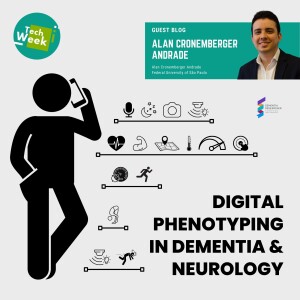
Dr Alan Cronemberger Andrade narrates his blog written for Dementia Researcher.
Digital interactions could be useful for tracking health states, especially for brain disorders. The problem is that this kind of data may be harder to protect, and less controlled by ourselves. People with dementia, and other cognitive and behavioural problems, are vulnerable to data insecurity. In this blog Alan describes what digital phenotyping is.. the good and bad aspects of using it, and some future perspectives behind ethical and methodological difficulties. Healthcare professionals and non-clinical researchers need to talk more about that.
Find the original text, and narration here on our website.
https://www.dementiaresearcher.nihr.ac.uk/guest-blog-digital-phenotyping-in-dementia-and-neurology-we-have-questions/
--
Dr Alan Cronemberger Andrade is a Neurologist and MSc Student in Neurology and Neuroscience at the Federal University of São Paulo in Brazil. He takes care of patients with neurological problems in diverse settings, and studies how digital technology interacts with the human brain in health and disease, focused on dementia and related disorders. His aim is to find how useful digital technologies could be in the near future, helping dementia patients and their caregivers. He loves writing, travelling, and reading about curious facts of ancient history.
If you would like to write for us, or join out team of regular contributors, drop us a line - dementiaresearcher@nihr.ac.uk

Monday Nov 07, 2022
Monday Nov 07, 2022
Hannah Hussain narrates her blog written for Dementia Researcher.
Its tech and dementia week, and in this blog Hannah explores how virtual reality is jumping out of the hands of gamers, and into the research space as a non-pharmalogical intervention.
Find the original text, and narration here on our website.
https://www.dementiaresearcher.nihr.ac.uk/guest-blog-virtual-reality/
--
Hannah Hussain is a PhD Student in Health Economics at The University of Sheffield. As a proud third generation migrant and British-Asian, her career path has been linear and ever evolving, originally qualifying as a Pharmacist in Nottingham, then Health Economics in Birmingham. Her studies have opened a world into Psychology, Mental Health and other areas of health, and with that and personal influences she found her passion for dementia.
--
Enjoy listening? We're always looking for new bloggers, drop us a line. http://www.dementiaresearcher.nihr.ac.uk
This podcast is brought to you in association with Alzheimer's Research UK and Alzheimer's Society, who we thank for their ongoing support.
Enjoy listening? We're always looking for new bloggers, drop us a line dementiaresearcher@ucl.ac.uk
Friday Nov 04, 2022
Friday Nov 04, 2022
Dr Anna Volkmer, narrates her blog written for Dementia Researcher.
When you publish a paper, you probably celebrate and share your news, telling your colleagues and everyone on social media - and everyone will probably share their congratulations. When you win a big grant, or a fellowship... do you want to share the news? Of course you do! However, when you know others are having a hard time or struggling, you may think twice... some may think "Good for you" and be inspired, others however may be less impressed.... how do you tell your colleagues who may only have a short time left on their contract that you just secured another 3, 4 or 5 years of funding? Anna has been thinking about resiliance, and how you celebrate success, following the exciting news of her new Fellowship award.
Find the original text, and narration here on our website.
https://www.dementiaresearcher.nihr.ac.uk/guest-blog-finding-your-cheer-team-maintaining-resilience-in-academia/
--
Dr Anna Volkmer is a Speech and Language Therapist and researcher in Language and Cognition, Department of Psychology and Language Sciences, University College London. Anna is researching Speech and language therapy interventions in language led dementia and was once voted scariest speech and language therapist (even her children agree).
If you would like to write for us, or join out team of regular contributors, drop us a line - dementiaresearcher@nihr.ac.uk
Wednesday Nov 02, 2022
Wednesday Nov 02, 2022
Dr Gaia Brezzo narrates her blog written for Dementia Researcher.
In this month’s blog, Gaia is reflecting back on a meeting she had with a member of the public earlier in the week. A stroke survivor, who has made it their goal to share with researchers, charities and funding bodies, their views and opinions. Sharing their lived experience of what it’s like to live with the aftermath of a stroke. Gaia also explores how important these voices are in research and how, perhaps, we should all be considering how we could be doing more.
Find the original text, and narration here on our website.
https://www.dementiaresearcher.nihr.ac.uk/guest-blog-the-importance-of-lived-experience-in-research/
--
Dr Gaia Brezzo is a Research Fellow based within the UK Dementia Research Institute at The University of Edinburgh. Gaia's research focuses on understanding how immune alterations triggered by stroke shape chronic maladaptive neuroimmune responses that lead to post-stroke cognitive decline and vascular dementia. Raised in Italy, Gaia came to the UK to complete her undergraduate degree, and thankfully, stuck around. Gaia writes about her work and career challenges, when not biking her way up and down hills in Edinburgh. Follow Gaia on Twitter: @Gaia_Brezzo
--
Enjoy listening? We're always looking for new bloggers, drop us a line. http://www.dementiaresearcher.nihr.ac.uk
This podcast is brought to you in association with Alzheimer's Research UK and Alzheimer's Society, who we thank for their ongoing support.
Monday Oct 31, 2022
Monday Oct 31, 2022
Beth Eyre narrates her blog written for Dementia Researcher.
If you're a jobbing scientist or researcher of any kind, you're probably familiar with imposter syndrome, also known as impostor phenomenon or impostorism. It's a psychological occurrence in which an individual doubts their skills, talents, or accomplishments and has a persistent internalized fear of being exposed as a fraud. Despite external evidence of their competence, those experiencing this phenomenon do not believe they deserve their success or luck. Well in this blog, Beth talks to some strategies that she has found help her in dealing with the effects.
Find the original text, and narration here on our website.
https://www.dementiaresearcher.nihr.ac.uk/guest-blog-hello-imposter-syndrome-my-old-friend/
We're always on the look out for new contributors, if you would like to write and narrate your own blog - drop us a line to dementiaresearcher@nihr.ac.uk
Don't forget to also listen to our fortnightly - published fortnightly, just look for Dementia Researcher in your podcast app.
--
Beth Eyre is a PhD Student at The University of Sheffield, researching Neurovascular and cognitive function in preclinical models of Alzheimer’s disease. Beth has a background in psychology, where she gained her degree from the University of Leeds. Inside and outside the lab, Beth loves sharing her science and in her blogs she discusses her work, career and shares lessons she learns as she navigates life as an early career researcher.
--
This podcast is brought to you in association with Alzheimer's Association, Alzheimer's Research UK, Alzheimer's Society and Race Against Dementia, who we thank for their ongoing support. Enjoy listening? We're always looking for new bloggers, drop us a line dementiaresearcher@ucl.ac.uk
Friday Oct 21, 2022
Friday Oct 21, 2022
Dr Anna Volkmer, narrates her blog written for Dementia Researcher.
With her recent promotion comes new found freedoms and responsibilities... not everyone who enters academia is lucky enough to find research 'freedom', but if you do, will you be ready to be your own boss? Don't worry, you got this, and so has Anna, who was recenltly appointed as an NIHR Senior Investigator. In this blog Anna discusses leadership, support and how you can be ready to step out on your own when the time comes.
Find the original text, and narration here on our website.
https://www.dementiaresearcher.nihr.ac.uk/guest-blog-going-on-my-own-being-my-own-boss-for-my-new-fellowship/
--
Dr Anna Volkmer is a Speech and Language Therapist and researcher in Language and Cognition, Department of Psychology and Language Sciences, University College London. Anna is researching Speech and language therapy interventions in language led dementia and was once voted scariest speech and language therapist (even her children agree).
If you would like to write for us, or join out team of regular contributors, drop us a line - dementiaresearcher@nihr.ac.uk
BlRISvsYP1JPEgVJbhH6