Dementia Researcher Blogs
The Dementia Researcher Blogs Podcasts - through this show, you can hear our bloggers read their blogs. So if you prefer to read, you can head or our website or you can listen on the move. These shows are about academic / research careers, research, science and life as an early career dementia researchers. Brought to you by https://www.dementiaresearcher.nihr.ac.uk - everything you need, all in one place. Remember to subscribe to our main ‘Dementia Researcher‘ Podcast, here and where ever you get your podcasts.
Listen on:






Episodes
Monday Jun 13, 2022
Monday Jun 13, 2022
Dr Sam Moxon, narrates his blog written for Dementia Researcher.
Sam has been doing some soul searching recently, and he got to thinking about health, remembering something that was mentioned in a recent podcast recording. Sam recently hosted a podcast with some pretty eminent researchers (check out the latest show on our main podcast) involved in the Race Against Dementia (RAD) initiative. One of the guests was talking about an interaction he had with Sir Jackie Stewart, the founder of the charity. He was recalling a conversation they shared where Sir Jackie expressed his frustration at how slow things seemed to move in dementia research. That was, I think, a part of the reason he started the charity. He wants to bring that F1 level of speed and innovation into the field. So how can we improve this image of slow progress, and try and feel a little better about our future? Sam explores in this blog.
Find the original text, and narration here on our website.
https://www.dementiaresearcher.nihr.ac.uk/guest-blog-are-we-proactive-enough-about-dementia/
--
Dr Sam Moxon is a biomaterials scientist at the University of Manchester. His expertise falls on the interface between biology and engineering. His PhD focussed on regenerative medicine and he now works on trying to develop 3D bioprinting techniques with human stem cells, so that we better understand and treat degenerative diseases. Outside of the lab he hikes through the Lake District and is an expert on all things Disney.
Enjoy listening and reading our blogs? We're always on the look out for new contributors, drop us a line and share your own research and careers advice dementiaresearcher@nihr.ac.uk

Tuesday Jun 07, 2022
Tuesday Jun 07, 2022
Dr Clarissa Giebel narrates her blog written for Dementia Researcher.
Only a few short years after completing a PhD you will (hopefully) find yourself as a new principal investigators (PIs), thrust into a role that includes administration and management, budgeting, mentoring and — perhaps most difficult — shepherding junior researchers to achieve their full potential. Many researchers receive little training in leadership skills to help them adapt, in this blog we hear from Clarissa as she makes the transition from student to supervisor.
Find the original text, and narration here on our website.
https://www.dementiaresearcher.nihr.ac.uk/guest-blog-from-phd-student-to-supervisor/
--
Dr Clarissa Giebel is a Research Fellow at the University of Liverpool and NIHR ARC North West Coast. Clarissa has been working in dementia care research for over 10 years focusing her research on helping people with dementia to live at home independently and well for longer, addressing inequalities that people with dementia and carers can face. Outside of her day work, Clarissa has also organised a local dementia network - the Liverpool Dementia & Ageing Research Forum, and has recently started her own podcast called the Ageing Scientist.
--
If you would like to write your own blog drop us a line, we're always on the look out for new contributors to write about their research, careers + more dementiaresearcher@nihr.ac.uk
Wednesday Jun 01, 2022
Wednesday Jun 01, 2022
Dr Aida Suárez-Gonzalez narrates her blog written for Dementia Researcher.
Lately Aida has been involved in many interview panels and, coincidentally, also in helping a substantial number of colleagues to prepare for grant and research job interviews. Her repeated exposure to the person specification assessment process in a short window of time has made Aida acutely aware of a few behaviours that she greatly appreciate in candidates - so to help you nail your next research job interview Aida is sharing her top 5 tips in her first contribution as a staff blogger for Dementia Researcher.
Find the original text, and narration here on our website.
https://www.dementiaresearcher.nihr.ac.uk/guest-blog-top-tips-to-nail-your-research-job-interview/
We're always on the look out for new contributors, if you would like to write and narrate your own blog - drop us a line to dementiaresearcher@nihr.ac.uk
Don't forget to also listen to our fortnightly - published fortnightly, just look for Dementia Researcher in your podcast app.
--
Dr Aida Suarez-Gonzalez is a Clinical Neuropsychologist and Senior Research Fellow at the Dementia Research Centre, UCL Institute of Neurology at Queen Square. With many years clinical experience working in Spain, Aida now investigating non-pharmacological interventions, services and assistive technologies to support people living well with dementia.
--
This podcast is brought to you from University College London in association with the National Institute for Health Research, Alzheimer's Research UK and Alzheimer's Society, who we thank for their ongoing support. Enjoy listening? We're always looking for new bloggers, drop us a line dementiaresearcher@ucl.ac.uk

Monday May 30, 2022
Monday May 30, 2022
Beth Eyre narrates her blog written for Dementia Researcher.
Giving presentations is something that you can’t always hide from in science, and it’s one of those things that if you put off, they just become more and more daunting. In this blog Beth provides some tips that others have passed on to her and from the experiences she has gainedover the past couple of years.
Find the original text, and narration here on our website.
https://www.dementiaresearcher.nihr.ac.uk/guest-blog-how-to-give-an-engaging-scientific-presentation/
We're always on the look out for new contributors, if you would like to write and narrate your own blog - drop us a line to dementiaresearcher@nihr.ac.uk
Don't forget to also listen to our fortnightly - published fortnightly, just look for Dementia Researcher in your podcast app.
--
Beth Eyre is a PhD Student at The University of Sheffield, researching Neurovascular and cognitive function in preclinical models of Alzheimer’s disease. Beth has a background in psychology, where she gained her degree from the University of Leeds. Inside and outside the lab, Beth loves sharing her science and we are delighted to have her contributing as a regular blogger with Dementia Researcher, sharing her work and discussing her career.
--
This podcast is brought to you from University College London in association with the National Institute for Health Research, Alzheimer's Research UK and Alzheimer's Society, who we thank for their ongoing support. Enjoy listening? We're always looking for new bloggers, drop us a line dementiaresearcher@ucl.ac.uk
Wednesday May 25, 2022
Wednesday May 25, 2022
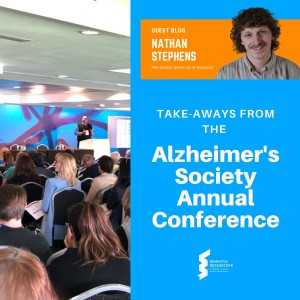
Nathan Stephens narrates his blog written for Dementia Researcher.
Earlier this month Nathan attended the Alzheimer’s Society annual conference at the Park Plaza Hotel London. This was his first in person event, where the focus of the day was on improving early diagnosis. The conference brought together professionals from all knucks and crannies of the health system, as well as academics, students, and most importantly people affected by dementia who played a part in every aspect of the day.
In this blog Nathan shares a few of my personal reflections, although, if anyone is reading this who did attend and find his recollection accurate, he apologises - there was a free bar!
Find the original text, and narration here on our website.
https://www.dementiaresearcher.nihr.ac.uk/guest-blog-alzheimers-society-annual-conference/
--
Nathan Stephens is a PhD Student and unpaid carer, working on his PhD at University of Worcester, studying the Worcestershire Meeting Centres Community Support Programme. Inspired by caring for both grandparents and personal experience of dementia, Nathan has gone from a BSc in Sports & Physical Education, an MSc in Public Health, and now working on his PhD.
--
Enjoy listening? We're always looking for new bloggers, drop us a line. http://www.dementiaresearcher.nihr.ac.uk
This podcast is brought to you in association with Alzheimer's Research UK and Alzheimer's Society, who we thank for their ongoing support.

Friday May 20, 2022
Friday May 20, 2022
Dr Yvonne Couch, narrates her blog written for the Dementia Researcher website.
OK so this one is going to be dull (Yvonne's words, not ours). There, I’ve said it. There will be no humour, no fun historical factoids and nothing exotic or interesting that you might use as pre-dinner conversation starters. But planning a budget for a grant is something that young researchers aren’t inherently prepared for, we often have no formal training and end up making it up as we go along. So in this blog Yvonne will give you some of my, albeit limited, experience in this area of academic life.
In order to make this easier we’ll split this into small grants, things that are less than 10k, medium grants of around 250k and large grants of more than 1 million. All of this is UK pounds by the way so if you’re listening in other countries the same rules apply just go in and change the numbers - so get your spreadsheets ready if you're in the middle of a grant application.
Find the original text, and narration here on our website.
https://www.dementiaresearcher.nihr.ac.uk/guest-blog-money-management/
--
Dr Yvonne Couch is an Alzheimer's Research UK Fellow at the University of Oxford. Yvonne studies the role of extracellular vesicles and their role in changing the function of the vasculature after stroke, aiming to discover why the prevalence of dementia after stroke is three times higher than the average. It is her passion for problem solving and love of science that drives her, in advancing our knowledge of disease. Yvonne has joined the team of staff bloggers at Dementia Researcher, and will be writing about her work and life as she takes a new road into independent research.
_____________________________________________________
Enjoy listening? We're always looking for new bloggers, drop us a line. http://www.dementiaresearcher.nihr.ac.uk

Wednesday May 18, 2022
Wednesday May 18, 2022
Hannah Hussain narrates her blog written for Dementia Researcher.
For today’s blog Hannah provides provide a guide on how to go about your first literature review. It may sound super daunting. But don't worry, Hannah is 2 years into her PhD, and 4 years into her research career, and she know's a thing or two! In this blog Hannah shares the tools and talks to the focused approach, your literature review needs, do it won't be a frightening task. So here it is, Hannah's complete guide to smashing out your literature review.
Find the original text, and narration here on our website.
https://www.dementiaresearcher.nihr.ac.uk/guest-blog-tops-tips-for-your-first-literature-review/
--
Hannah Hussain is a PhD Student in Health Economics at The University of Sheffield. As a proud third generation migrant and British-Asian, her career path has been linear and ever evolving, originally qualifying as a Pharmacist in Nottingham, then Health Economics in Birmingham. Her studies have opened a world into Psychology, Mental Health and other areas of health, and with that and personal influences she found her passion for dementia.
--
Enjoy listening? We're always looking for new bloggers, drop us a line. http://www.dementiaresearcher.nihr.ac.uk
This podcast is brought to you in association with Alzheimer's Research UK and Alzheimer's Society, who we thank for their ongoing support.
Enjoy listening? We're always looking for new bloggers, drop us a line dementiaresearcher@ucl.ac.uk
Friday May 13, 2022
Friday May 13, 2022
Dr Sam Moxon, narrates his blog written for Dementia Researcher.
It’s Mental Health Awareness Week and Sam thought it would be a good opportunity to talk about something that he has recently started to experience. It’s very much one of those “this is an issue I have and, by talking about it, maybe anyone else affected will find some comfort or useful advice” sort of blogs, for Sam, this is the challenge of living with a chronic illness, and how that can impact your mental health and not just the physical.
Find the original text, and narration here on our website.
https://www.dementiaresearcher.nihr.ac.uk/guest-blog-the-mental-struggle-of-living-with-chronic-illness/
--
Dr Sam Moxon is a biomaterials scientist at the University of Manchester. His expertise falls on the interface between biology and engineering. His PhD focussed on regenerative medicine and he now works on trying to develop 3D bioprinting techniques with human stem cells, so that we better understand and treat degenerative diseases. Outside of the lab he hikes through the Lake District and is an expert on all things Disney.
Enjoy listening and reading our blogs? We're always on the look out for new contributors, drop us a line and share your own research and careers advice dementiaresearcher@nihr.ac.uk
Thursday May 12, 2022
Thursday May 12, 2022
Adam Smith narrates his blog written for Dementia Researcher.
It's Mental Health Awareness Week and in this blog Adam discusses his own problems with anxiety, how he is coping and explores where they stem from and why talking about Mental Illness and Mental Health is important, not just to help you, but also to reduce the stigma associated with it.
The ISTAART / UCL survey of Early Career Dementia Researchers asked about Mental Health - 57% of people who responded said they had experienced Mental Health problems, with Anxiety, Depression and Loneliness being the biggest challenge. Sadly, only 37% said their employers / institutions were helpful, which is terrible when you consider that the same people reported that it impacted their effectiveness at work, confidence, motivation and how they interacted with co-workers and supervisors.
Find the original text, and narration here on our website.
https://www.dementiaresearcher.nihr.ac.uk/guest-blog-a-mental-health-update/
--
Adam Smith was born in the north, a long time ago. He wanted to write books, but ended up working in the NHS, and at the Department of Health. He is now Programme Director in the Office of the NIHR National Director for Dementia Research (which probably sounds more important than it is) at University College London. He has led a number of initiatives to improve dementia research (including this website, Join Dementia Research & ENRICH), as well as pursuing his own research interests. In his spare time, he grows vegetables, builds Lego & spends most of his time drinking too much coffee and squeezing technology into his house.
_____________________________________________________
Enjoy listening? We're always looking for new bloggers, drop us a line. http://www.dementiaresearcher.nihr.ac.uk